
Why Toyota Cars Sell More Than Maruti Even When They Are Expensive
Innova Hycross and Maruti Invicto are the same car. One has a 3-month waiting list. The other is rotting in dealerships


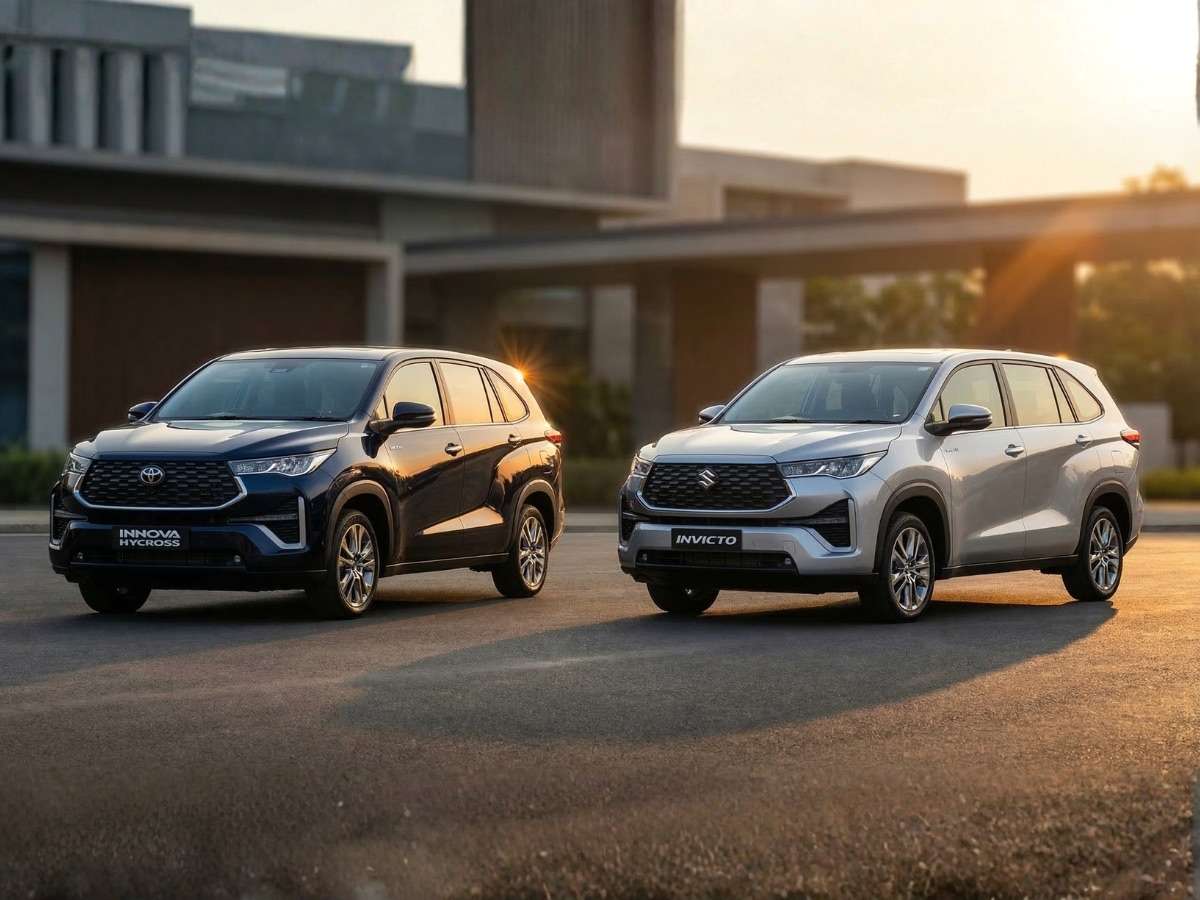
Every month, nearly 15 times more Toyota Innova Hycross units are sold compared to the Maruti Invicto, even though the Invicto is almost ₹6 lakh cheaper, and both cars come from the same factory, with the same powertrain, same features, and 95% identical parts.
This is not an accident. It is a pattern that is now threatening to unravel one of the most talked-about automotive partnerships in India — and it tells you everything about the power of a brand name.
"A rational buyer would always pick the cheaper car. But 95% of Indians didn't — and there is a very logical reason why."
Quick Numbers: Why This Story Matters
| Metric | Number |
|---|---|
| Hycross sells more than Invicto (monthly) | ~15 Times |
| Price premium Toyota commands | ~₹6 Lakh |
| Toyota India market share (was 3.1%) | 7.8% |
| Maruti India market share (was 50%) | ~40% |
| Toyota annual sales in India now (was 1 lakh) | ~3 Lakh |
| Toyota India record profit | ₹5,600 Crore |
Innova Hycross vs Maruti Invicto: The Same Car, Two Very Different Fates
Let's be clear about what we are comparing. The Toyota Innova Hycross and the Maruti Suzuki Invicto are both 7-seater MPVs built on the same platform. They share the same 2.0L strong hybrid powertrain, the same cabin dimensions, and nearly identical feature lists. The only real differences are the badge on the front and the number on the price tag.
| Feature | Toyota Innova Hycross | Maruti Invicto |
|---|---|---|
| Starting Price | ~₹21 Lakh | ~₹18 Lakh |
| Powertrain | 2.0L Strong Hybrid | Same 2.0L Strong Hybrid |
| Waiting Period | 2–3 Months | Immediate Delivery |
| Monthly Sales | ~8,000–10,000 Units | ~500–700 Units |
| Platform | Same | Same |
| Parts Commonality | 95% | 95% |
The Invicto is sitting at dealerships right now, at a lower price, with zero waiting period. The Hycross has a 2–3 month waiting list. This is the power of a brand — and it is currently costing Maruti dearly.
Why Did Toyota That Is 15 Times Bigger Than Suzuki, Even Need This Deal?
Toyota's global revenue is roughly 11 times that of Suzuki. Their most expensive car costs 15 times more than Suzuki's priciest model. Their annual profits are 10 times higher. So why did the world's largest automaker need to partner with an affordable Indian brand to grow in India?
Because Toyota tried going it alone in India — and failed badly.
The Etios Story: ₹3,200 Crore Invested, Zero Result
In the early 2000s, Toyota invested ₹3,200 crore to develop a fully localized, affordable car for India. After years of research and development, they launched the Toyota Etios in 2010 at ₹5 lakh, their most affordable car ever made.
The first 17 months brought nearly 1 lakh units in sales. Decent numbers, but well below Toyota's expectations. Then things fell apart rapidly, for three specific reasons:
Reason 1 — The Tax Trap: The Etios was 4.2 metres long just above India's critical 4-metre GST threshold. Competitors like the Honda Amaze and Maruti Dzire were under 4 metres. This meant the Etios faced nearly double the tax burden. To keep prices competitive, Toyota stripped out safety features, including airbags. Buyers noticed.
Reason 2 — Poor Build Quality: The Etios had arguably the worst door visors ever put on an Indian car. It had a single windshield wiper, feature that has historically killed every car it has ever been fitted on in India. The speedometer was mounted in the center of the dashboard instead of in front of the driver. Toyota used lighter metals to cut the car's weight down to just 850 kg, number that inspires zero confidence in safety.
Reason 3 — The Taxi Stigma: By 2016, over 60% of Etios sales were going to fleet operators and taxi drivers, which damage the market for retail sales, by which sales essentially collapsed. When BS6 norms arrived in 2020, Toyota chose to discontinue the Etios rather than spend money upgrading it.
The Joint Venture That Changed Everything
With the Etios gone and their India presence shrinking, Toyota turned to an unlikely ally: Suzuki. The structure of the deal they agreed on is genuinely clever.
Toyota gives Suzuki: Advanced hybrid technology for use in European markets, helping Suzuki comply with strict EU emission regulations.
Suzuki gives Toyota: Affordable, locally-produced cars that Toyota rebadges and sells across India and globally, helping Toyota expand its lineup and comply with India's CAFE (Corporate Average Fuel Efficiency) norms without having to build those cars themselves.
Suzuki immediately offered its two best-selling cars the Brezza and Baleno to Toyota as the Urban Cruiser and Glanza respectively. Within a few months, combined sales of these two rebadged cars crossed 1 lakh units.
How the Collaboration Evolved — Year by Year
2017: Toyota-Suzuki joint venture officially announced. Hybrid tech flows to Suzuki for Europe. Affordable cars flow to Toyota for India.
2021: Glanza (rebadged Baleno) and Urban Cruiser (rebadged Brezza) launched in India. Early response is strong.
2022: Grand Vitara and Urban Cruiser Hyrider launched — the first time a Maruti platform received Toyota's strong hybrid technology. Grand Vitara initially outsells Hyrider 2:1 due to a lower entry price.
2023: Innova Hycross launches and becomes a blockbuster. Maruti launches the identical Invicto at ₹3 lakh less — and barely anyone buys it. Toyota's India market share jumps from 3.1% to 7.8%.
2024: Grand Vitara now sells only 20% more than Hyrider (down from 100% more in 2022-23). Specifically: 1,44,000 Grand Vitaras vs 85,000 Hyriders in the last year. Maruti starts withholding its newest cars from Toyota. Toyota posts all-time record profits of ₹5,600 crore.
2025 onwards: Toyota announces $3 billion investment in India, new plants in Bidadi (Karnataka) and Maharashtra, and 15 car launches by 2030.
Who Is Actually Winning This Partnership?
On paper, both brands should benefit equally. In practice, Toyota is winning — by a large margin.
Toyota went from selling 1 lakh cars a year in India to nearly 3 lakh. Their previously underutilized factory now runs at near full capacity, reducing fixed costs per vehicle. They are exporting cars made in India. Their dealerships earn more money per outlet than a Mercedes-Benz dealership in India. They posted record profits of ₹5,600 crore.
For Maruti, the results are painful. Their India market share fell from 50% to 40%. A large part of Toyota's growth came directly from Maruti's own cars — carrying Toyota's badge and priced higher than the Maruti original.
The Hidden Reason: CAFE Norms
India's CAFE norms require that a company's entire fleet must average at least 21.3 km/l in fuel efficiency. For Toyota, this is nearly impossible when you are mainly selling Fortuners (10 km/l) and Innova Hycross vehicles.
By selling Glanzas and Hyriders, which deliver excellent mileage, Toyota pulls its fleet average up. This is why a Toyota Fortuner is still affordably priced: someone buying a Glanza is effectively subsidizing it. Without those small, efficient cars, Toyota's SUV prices would be ₹3 lakh higher.
Under CAFE 3 norms coming in the near future, this calculation gets even more critical, pushing Toyota toward more hybrids and EVs, faster. Note: one electric vehicle counts as three cars for the purpose of fleet efficiency calculations, which is a huge incentive for Toyota to launch its EVs in India.
Every Toyota Car Expected to Launch in India by 2030
Toyota has committed to launching 15 new cars in India by 2030. Here is a complete breakdown:
⚡ Electric Vehicles
| Car | Key Details | Expected Price |
|---|---|---|
| bZ4X EV | Toyota's eVX rebadge. 49 or 61 kWh battery. Launching 2025. Mainly for CAFE credits. | ~₹40–45 Lakh |
| C-HR EV | Sharp styling, 77 kWh battery. Already launched internationally. | ~₹30 Lakh |
| Hilux EV | 60 kWh battery, 250 km range, 1,600 kg towing capacity. Niche fleet product. | ~₹40 Lakh |
| Mini Fortuner EV | TNGA platform, Creta-plus size, electric version expected. | ~₹25 Lakh |
| Grand Highlander EV | 7-seater. 350 hp, ~500 km range. Already launched in USA. India possible. | ~₹80 Lakh |
🌿 Hybrid Vehicles
| Car | Key Details | Expected Price |
|---|---|---|
| New RAV4 | Internationally revealed. 350 hp top model, 100 km EV-only range. 2-year waiting list globally. | ~₹40 Lakh |
| Toyota 340D Mid-Size SUV | Toyota's own in-house SUV. 2.0L hybrid, ~200 hp, 4.4m length. Direct Creta rival. | ~₹25 Lakh |
| Hyrider 7-Seater | Grand Vitara 7-seater confirmed. Hyrider 7-seater version to follow. Same hybrid powertrain. | ~₹22–25 Lakh |
| Prius | Not for volume — mainly for fleet efficiency credits. Strong brand recognition. | ~₹45 Lakh |
| Crown / New Camry | Premium hybrid sedans for corporate and luxury segment. | ₹45–65 Lakh |
| Frontlander | 2.4L hybrid, 324 hp, off-road tuned, rugged looks. Strong value if priced at ₹70 lakh. | ~₹70 Lakh |
🔥 Petrol and Diesel Vehicles
| Car | Key Details | Expected Price |
|---|---|---|
| New Fortuner Facelift | Testing in Thailand. New front fascia, alloys, tail lights. Same 2.2L with 48V mild hybrid. | ₹50 Lakh+ (base) |
| Land Cruiser LC250 | Launching in USA and Australia. Fortuner engine. Could undercut Defender if built locally. | ₹80–90 Lakh |
| IMV Zero (MG Cruzer) | Sub-Fortuner off-roader, 4.4m, Fortuner engine, off-road tech. Testing in Thailand. Expected 2027. | ~₹25 Lakh |
| Raize (Sub-4m SUV) | Toyota needs a sub-4m product after Urban Cruiser was discontinued. 1.0L turbo, 120 hp. | ~₹10–14 Lakh |
| New HiLux | Updated version seen globally. Slim new lights, refreshed dashboard. | ~₹45 Lakh |
The Bigger Picture: India Is Replacing China for Japanese Automakers
Between 2010 and 2020, every major Japanese automaker poured money into China. Toyota, Honda, Nissan, all of them bet heavily on Chinese growth.
Then from 2021 onwards, Chinese automakers started dominating their own market with technology, features, and pricing that Japanese brands simply could not match. By 2024, Japanese brands in China were facing serious market share declines.
The pivot to India was fast. Toyota's India investments grew 7 times between 2021 and 2024. They are now planning to invest $3 billion in India — a new plant in Bidadi, Karnataka, and a greenfield plant in Maharashtra. Annual production capacity will reach 10 lakh vehicles. Cars built in India will also be exported globally.
Toyota has stated it will launch 15 cars in India by 2030, and the company is now targeting India the way it once targeted China.
Key Takeaway
Toyota used Maruti's cars to rebuild its India presence. It used CAFE norms to justify the partnership. It is now profitable enough to go independent. Maruti helped Toyota grow — at the cost of its own market share. The partnership may have started as mutually beneficial, but the balance has shifted heavily. And Toyota is only accelerating.
Note: Analysis based on publicly available sales data, CAFE regulatory filings, and automotive industry reports. Some forward-looking launch details are based on industry expectations and may change.
About the Author

CarzOnWheel Team shares practical insights on cars, ownership, and the latest updates to help readers make informed decisions.