
Car AC Service Cost in India 2026
Car AC service cost in India runs ₹999 to ₹3,399, with gas refill, compressor and cooling coil priced separately. Full 2026 breakdown by part, car and workshop type


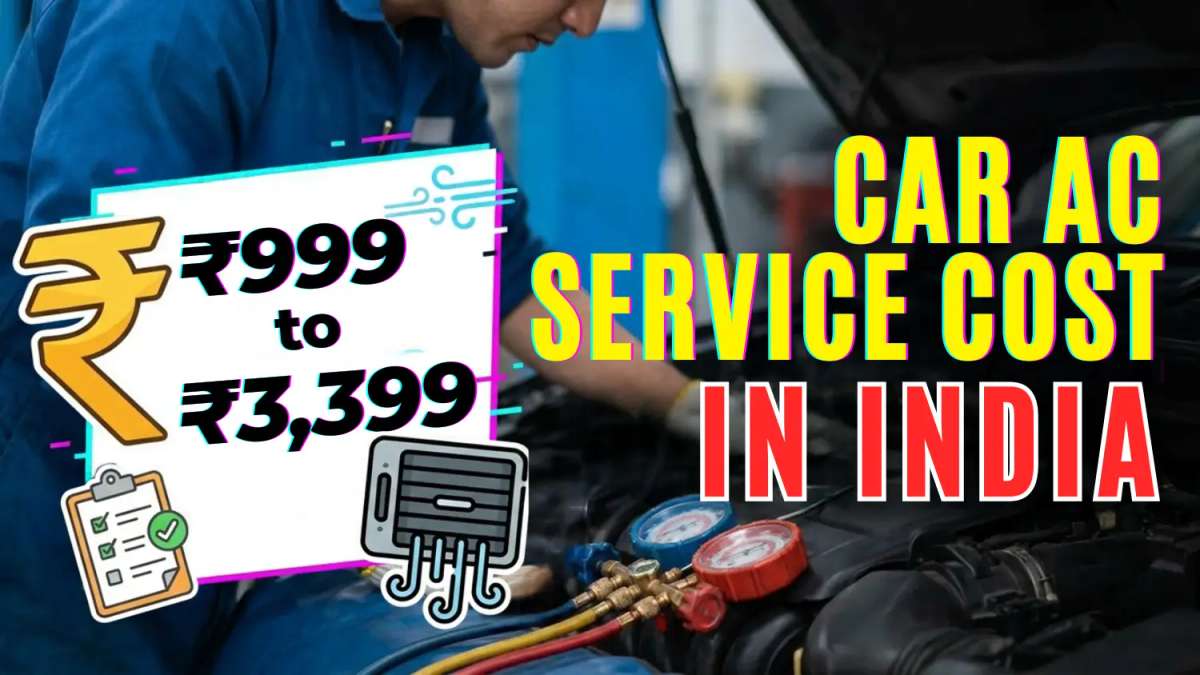
Car AC service cost in India starts at about ₹999 for a gas top-up and goes up to ₹3,399 for a full service with coil cleaning and compressor oil.
A car AC service is not one fixed job. At the lower end you get refrigerant topped up, the condenser cleaned and the cabin filter done. At the higher end you also get cooling coil cleaning, fresh compressor oil and a leak check before any gas goes in.
Most owners pay somewhere between ₹1,500 and ₹2,500. Three things decide what YOU pay: what is actually wrong with the AC, which refrigerant your car uses, and whether you go to a dealer, a chain workshop or a local mechanic.
Here is the full picture:
Full Car AC Service Cost Breakdown in India
Below, I have mentioned what you actually pay when you get your car AC service done. (write how you picked prices in a way it feels authoritative and build EEAT) Prices are typical market rates for a mass-market hatchback or sedan in a metro. A compact SUV adds roughly 10 to 15 percent. Luxury cars are a separate conversation and get their own section below.
|
Job |
What you get |
Typical cost |
How often |
|
AC inspection |
Pressure check, cooling test, visual leak check |
₹49 – ₹800 |
When cooling drops |
|
AC gas top-up |
Refrigerant added, nothing else |
₹999 – ₹1,500 |
Only if low |
|
Basic AC service |
Gas up to 400g, condenser cleaning, filter cleaning |
₹1,500 – ₹1,949 |
Every 2 to 3 years |
|
Full AC service |
All of the above plus cooling coil cleaning and compressor oil |
₹2,500 – ₹3,399 |
Every 3 years |
|
Cabin filter replacement |
New filter fitted |
₹450 – ₹1,200 |
Every 10,000 km |
|
Condenser cleaning only |
External coil washed |
₹99 – ₹500 |
Yearly, before summer |
|
Cooling coil cleaning |
Evaporator cleaned, often needs dash work |
₹1,200 – ₹2,500 |
When smell appears |
Two numbers in that table do most of the work. The ₹999 top-up and the ₹1,949 basic service look similar on an invoice but they are not the same job, and the gap between them is where most of the confusion about car AC service cost comes from.
What a Car AC Service Includes at Each Price
A top-up is a technician connecting a gauge and adding gas until the pressure reads right. It takes fifteen minutes. If your AC was cooling fine last month and is weak now, a top-up will make it cold again for a while. It will not tell you why the gas went missing.
A proper service is a longer job. The old refrigerant is recovered rather than vented. The system is pulled into vacuum and held there, which is how a technician confirms it is not leaking. Only then is the correct weight of gas charged back in, along with compressor oil. The condenser at the front of the car gets washed, and on a full service the cooling coil behind the dashboard gets cleaned too.
That vacuum hold is the part worth paying for. It is the difference between fixing the symptom and finding the cause, and it is usually the first thing dropped when a workshop quotes you a low number.
Basic car AC service
Expect ₹1,500 to ₹1,949. You get refrigerant up to around 400 grams, condenser cleaning and the cabin filter cleaned rather than replaced. This is enough for a car that cools well and is just due a seasonal check.
Full car AC service
Expect ₹2,500 to ₹3,399. Adds cooling coil cleaning and fresh compressor oil. Worth it if the air smells musty, if cooling has dropped gradually over two summers, or if the car has crossed 40,000 km without the AC ever being opened up.
Car AC gas refill cost depends on which gas your car uses
This is where most published prices go wrong, and where owners of newer cars get a shock at the counter.
Indian cars run one of two refrigerants. The older and far more common one is R-134a. The newer one, R-1234yf, is chemically kinder to the atmosphere and considerably more expensive. At trade level R-134a costs roughly ₹500 to ₹800 a kilogram. R-1234yf costs ₹5,000 to ₹8,000 a kilogram. Same job, same time in the bay, and a bill that differs by several thousand rupees.
|
Refrigerant |
Cars that use it |
Charge weight |
Refill cost |
|
R-134a |
Roughly 85% of cars on Indian roads. Maruti, Hyundai, Tata, Honda and Toyota models through most of the last two decades |
400 – 650 g |
₹1,200 – ₹3,500 |
|
R-1234yf |
Post-2020 Volkswagen Taigun and Virtus, Skoda Kushaq and Slavia, plus Audi, BMW, Mercedes-Benz and Volvo |
500 – 900 g |
₹6,500 – ₹13,000 |
You do not have to guess which one you have. Open the bonnet and look for a sticker near the radiator support or on the underside of the bonnet itself. It names the refrigerant and the exact charge weight in grams. Photograph it. If a workshop quotes you a flat price without asking which gas your car takes, that is worth a question.
Why car AC gas costs less in India than almost anywhere else
Europe pushed R-134a out of new cars roughly a decade ago. India is on a slower timetable. Under the Kigali Amendment, which India ratified in 2021, the country phases down these gases in four steps starting in 2032: a 10 percent cut in 2032, 20 percent in 2037, 30 percent in 2042 and 85 percent by 2047.
The practical meaning for an owner is simple. R-134a will stay cheap and widely available in India through this decade. If your car uses it, the refill prices above are likely to hold. If your car is new enough to use R-1234yf, that gas is expensive now and will stay expensive, so a leak is worth fixing properly rather than topping up twice a year.
Car AC repair cost by part
Servicing is the small bill. Repairs are where the numbers get serious. These ranges cover part and labour together, at organised workshops in metro cities.
|
Part |
Hatchback |
Sedan |
SUV |
|
AC compressor (OEM) |
₹12,500 – ₹17,000 |
₹15,000 – ₹22,000 |
₹18,000 – ₹28,000 |
|
AC compressor (aftermarket) |
₹9,500 – ₹12,000 |
₹11,000 – ₹15,000 |
₹13,000 – ₹19,000 |
|
Cooling coil / evaporator |
₹5,500 – ₹8,500 |
₹6,500 – ₹9,500 |
₹7,500 – ₹11,000 |
|
Condenser |
₹4,500 – ₹7,000 |
₹5,000 – ₹8,000 |
₹6,000 – ₹9,500 |
|
Condenser fan motor |
₹2,500 – ₹4,500 |
₹3,000 – ₹5,500 |
₹3,500 – ₹6,500 |
|
Blower motor |
₹2,000 – ₹3,500 |
₹2,270 – ₹4,500 |
₹2,800 – ₹5,500 |
|
Cabin filter |
₹450 – ₹900 |
₹500 – ₹1,000 |
₹600 – ₹1,200 |
|
AC relay or sensor |
₹400 – ₹1,500 |
₹400 – ₹1,500 |
₹500 – ₹1,800 |
One line in that table deserves a warning. The cooling coil sits behind the dashboard. Replacing it means the dashboard comes out, which on most cars is the better part of a day's labour. The part might cost ₹5,500 but the job can land closer to ₹9,000 once labour is counted. Always ask for the labour figure separately on this one.
Compressors are the other big-ticket item. An aftermarket unit saves real money and is a reasonable choice on an older car. On a car still under warranty, fitting a non-genuine compressor can complicate a future claim, so weigh that before saving ₹4,000.
Car AC service cost at a dealer, a chain and a local mechanic
Same job, three prices. Here is the honest comparison.
|
Authorised dealer |
Organised chain |
Local mechanic | |
|
Full AC service |
₹3,000 – ₹6,000 |
₹1,949 – ₹3,399 |
₹1,200 – ₹2,000 |
|
Gas authenticity |
Genuine, sealed |
Usually branded |
Varies, ask to see the cylinder |
|
Recovery and vacuum |
Standard |
Usually |
Often skipped |
|
Written itemised bill |
Yes |
Yes |
Sometimes |
|
Warranty impact |
Safe |
Generally safe |
Can complicate a claim |
A dealer is the right choice while the car is in warranty, or if the fault is electronic and needs the manufacturer's diagnostic tool. You are paying a premium for record-keeping and genuine parts, and on a car still covered that premium is usually worth it.
A chain workshop is the middle ground most owners should take once the warranty lapses. Fixed package pricing, proper recovery equipment, and an invoice you can read.
A good local mechanic is the cheapest route and often technically excellent, particularly on older cars. The risk is not skill, it is equipment and gas quality. Refrigerant sold loose from an unmarked cylinder can be cut with other gases, and a shop without a recovery machine will vent your old gas to the air and skip the vacuum step entirely. Ask two questions: can I see the gas cylinder, and do you pull vacuum before charging. The answers tell you most of what you need to know.
Signs your car needs AC repair, and what each one costs
Matching the symptom to a likely bill before you reach the workshop is the best protection against being sold something you do not need.
|
What you notice |
Usual cause |
Likely cost |
|
Air flows but is not cold |
Low refrigerant, usually from a leak |
₹1,500 – ₹3,500 |
|
Weak airflow at every setting |
Clogged cabin filter |
₹450 – ₹1,200 |
|
Cools while driving, warm in traffic |
Condenser fan or blocked condenser |
₹500 – ₹4,500 |
|
Musty smell on startup |
Mould on the cooling coil |
₹1,200 – ₹2,500 |
|
Rattle or whirring when AC is on |
Compressor clutch or bearing |
₹2,500 – ₹5,000 |
|
Water pooling in the footwell |
Blocked drain pipe |
₹300 – ₹800 |
|
Engine temperature climbs with AC on |
Radiator or fan fault, not the AC itself |
₹1,299 – ₹4,200 |
|
AC stops cooling suddenly and completely |
Compressor failure or an electrical fault |
₹400 – ₹28,000 |
That last row spans an enormous range for a reason. A dead AC can be a ₹400 relay or a ₹20,000 compressor, and there is no way to tell from the driver's seat. Pay for the diagnostic scan, which runs ₹300 to ₹800, before authorising any part.
How often car AC service is actually needed
The car AC service time period worth following is once a year for cleaning and checking, and roughly once every three years for anything involving gas.
The yearly job is small. Condenser washed, cabin filter changed, cooling checked, drain cleared. Do it in February or March, before the summer rush, when workshops are quieter and often cheaper.
Gas is different, and this is the part that costs owners the most money over the life of a car. A car air conditioner is a sealed loop. The refrigerant inside is not burned off or used up the way engine oil or fuel is. It circulates, cools the cabin, and circulates again. In a healthy system it stays there.
Experienced technicians put a genuine refill at about once every three years, as part of a full service where the system is opened anyway. If your car needs gas every single summer, the gas is going somewhere. There is a leak, most often at an O-ring, a hose crimp or the compressor front seal, and topping it up each year means paying for the same gas repeatedly while never fixing the ₹800 seal that is letting it out.
Ask this before you agree to gas
Ask the workshop to do a leak test first and show you the result. A dye test or a nitrogen pressure hold takes very little time. If the system holds pressure, the gas was genuinely just low. If it does not, you have found the real repair, and it is usually cheaper than three years of refills.
There is one more reason not to delay. Running an AC that is low on gas starves the compressor, because the compressor's lubricating oil travels around with the refrigerant. Less gas means less oil reaching the moving parts. That is how a ₹2,000 refill becomes a ₹16,000 compressor a year later. If the cooling drops noticeably, get it looked at that month rather than that season.
Is car AC service included in the regular car service cost
Partly, and the gap catches people out. A standard periodic service at a dealer usually includes the cabin air filter and a basic cooling check. Both are quick, and both appear on the job card without a separate charge.
What is almost never included is refrigerant, cooling coil cleaning, condenser washing beyond a rinse, or any diagnosis of an AC fault. Those are billed separately, which is why an owner who booked a ₹6,000 periodic service can end up with a ₹9,000 invoice after the advisor adds AC work.
If you want AC work done alongside a periodic service, say so at booking and ask for it quoted as a separate line. It costs the same and removes the surprise.
How to keep your car AC service cost down
Book before the season. AC work peaks from April through June and prices, waiting times and upselling all rise with the temperature. February and March are the cheap months.
Insist on an itemised invoice. Gas, labour, filter and any parts should each carry their own figure. A single line reading "AC service" tells you nothing and makes a second opinion impossible.
Run the AC for ten minutes a month through winter. The compressor seals stay lubricated when the system circulates, and seals that dry out are the most common source of the slow leaks that lead to annual refills.
Clean the condenser yourself. It sits at the front of the car, ahead of the radiator, and it collects road grime and insects. A gentle rinse with a garden hose, water only and no pressure washer, restores cooling that owners often mistake for low gas. This is a genuinely free fix and it works more often than you would expect.
Change the cabin filter on schedule. At ₹450 to ₹1,200 it is the cheapest part in the system, and a blocked one makes the AC work harder, cools worse and shortens blower motor life.
About the Author

Bharat Rana shares practical insights on cars, ownership, and the latest updates to help readers make informed decisions.