
RTO Approved Sun Control Film for Car in India VLT Rules & Legal Options
There's one number that decides whether your sun film gets you a challan. It is not the number printed on the film. Explained below.


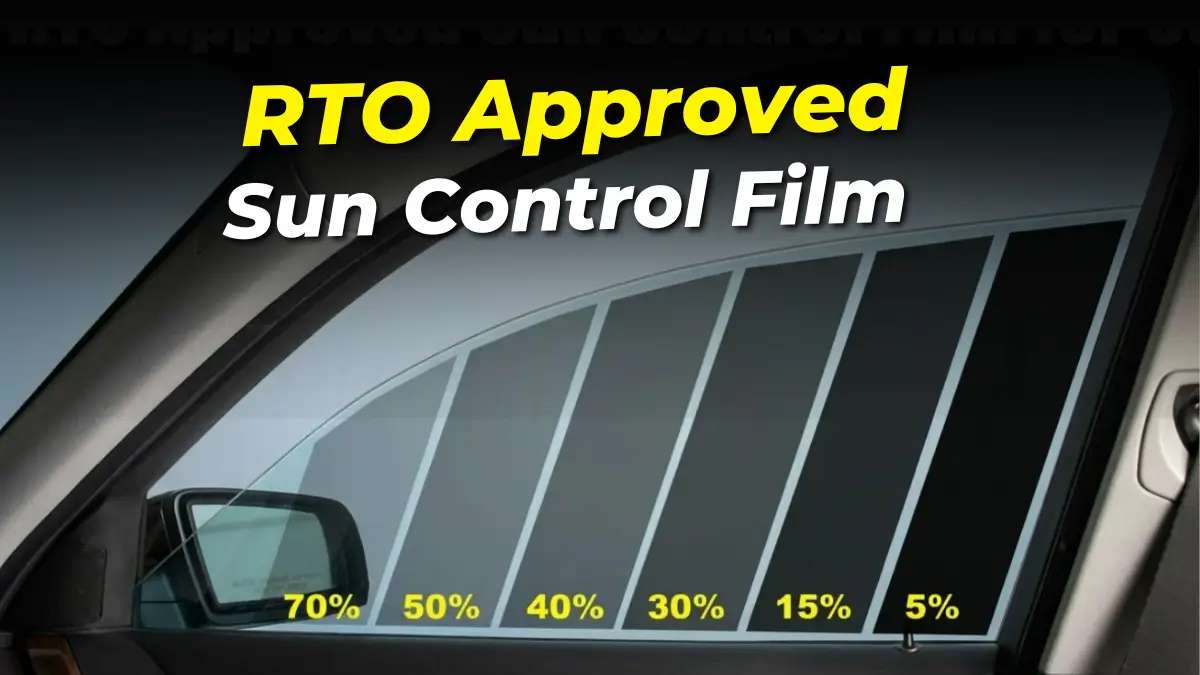
Walk into any car accessory shop and ask for an RTO approved sun control film for car glass. You will be handed a roll with an “RTO Approved” sticker on it.
That sticker means nothing.
No RTO (Regional Transport Office) in India approves sun control film. There is no approved list. The rule was never written about film in the first place.
The rule was written about how much daylight should pass through your car glass. Once you know how this light gets measured, the confusion clears up fast.
Why There Is No RTO Approved Sun Control Film in India
The law here is Rule 100 of the Central Motor Vehicles Rules, 1989. This law decides how much daylight must pass through your window. That is the whole rule. There is no role for RTO rules.
So when a constable stops you, he does not check your bill. He clamps a small device called a tint meter onto the glass and reads a number displayed below:
Car Window Tint Rules in India for Only Two Numbers that Matter
The measurement is called VLT, short for visible light transmission. It tells you how much daylight gets through the glass. A higher VLT means a clearer window, so 70% VLT is quite clear. 20% VLT is very dark.
The permissible VLT for car glass under Rule 100 is 70% for the front windscreen and the rear windscreen. For the side windows it is 50%. Nothing else in the rule changes those two figures.
That is it. Two numbers. Every argument you have ever heard about sun film comes back to them.
Why a 70% Film Still Fails the Legal VLT for Car Windows Test
Most car windows already sit around 75% to 80% VLT before you drive them out of the showroom. The film goes on top of that glass. Light has to pass through both.
So the two figures multiply. Take glass at 80% and add a film sold as 70%. Multiply them and you land near 56%.
On your side windows, 56% clears the 50% limit comfortably. On your windscreen, 56% fails a 70% limit and the challan is valid. The film was never mis-sold. The buyer just assumed the number on the box was the number the meter would read.
This single point is why so many owners with legal-looking film still get stopped. VLT rules for car windows apply to the finished window, not to the roll you bought.
Supreme Court Car Sun Film Rule Changes Between 2012 and 2024
In May 2012, the Supreme Court decided Avishek Goenka v. Union of India. The court read Rule 100 as applying to the glass itself and banned black films of any darkness from 4 May 2012. This is the ruling people half remember when they say sun film is banned.
Then the rule changed. From 1 April 2021, safety glazing was added to Rule 100 alongside safety glass. Glazing that meets Indian Standard IS 2553 (Part 2), First Revision, 2019 and stays within the 70 and 50 limits now sits inside the rule rather than outside it.
For three years nobody agreed on whether that covered film fitted after purchase. Then in September 2024 the Kerala High Court settled it in its jurisdiction. In M/s George & Sons v. Union of India (2024:KER:68346), Justice N. Nagaresh held that there is no bar on fitting sun film that meets the prescribed standard and does not breach the VLT limits, and that the state cannot penalise a vehicle for compliant safety glazing.
So the Supreme Court car sun film rules of 2012 were about films that broke the standard. The 2021 amendment created a lane for films that meet it. Both things are true, which is exactly why the shop and the constable can quote you opposite answers and both sound confident.
Sun Control Film for Car Legal or Illegal?
A High Court ruling binds its own state. Kerala's judgment is strong there. It is not a national clearance, and no other bench is required to follow it.
Meanwhile enforcement has gone the other way. Delhi Traffic Police issued 2,235 tinted glass challans in the first week of November 2025 alone, and around 20,232 across the year. Gurugram crossed 6,000 in a single month. Karnataka ran a summer drive where film was peeled off vehicles at the roadside.
So is car sun film legal in India? On paper, yes, if it keeps the window inside 70 and 50. On the road, it depends on the officer, the meter and the state you are driving through that day. Plan for the meter, not for the judgment.
Challan for Sun Film: What Getting Caught Actually Costs
The central figure quoted everywhere is low. Most insurance sites still list ₹100 for a first offence and ₹300 for a repeat, which come from an older schedule and are almost never what you pay.
States charge far more. Delhi is commonly reported around ₹2,000 for a first offence. Maharashtra runs between ₹1,000 and ₹5,000 depending on the case. Repeat offences can bring vehicle detention and, in some states, action on the licence. Check your own state's e-challan schedule, because the amount and the section used both vary.
But the money is rarely the real cost. A challan for sun film usually ends with the film being scraped off at the signal. Pay ₹20,000 for a premium fit in March, lose it at a checkpoint in May, and the fine is the smallest part of that.
RTO Approved Car Glass Film Price in India: ₹142 to ₹21,500
Rolls start at ₹142 on Amazon. Professional jobs cross ₹20,000. That is a hundredfold gap for what looks like the same thing.
The cheap end is dyed polyester. It darkens the glass, fades to purple in two summers, and comes with no VLT documentation you could show anyone. The expensive end is ceramic or multi-layer safety glazing with a stated VLT, an infrared rejection figure and a warranty.
Real numbers help. A Garware Ice Cool Shield SG job runs around ₹15,000 for a full car and holds VLT near 82%. The Arctic Cool Shield SG sits closer to ₹21,500 with VLT around 79%. Sunroof film is priced separately, usually ₹6,000 to ₹18,000 depending on the size of the glass.
Now the honest trade-off. A high VLT sun control window film is legal and clear, but it cuts less heat than the dark stuff your neighbour has. You are paying for infrared rejection, not for darkness. If you want a cabin that feels cold and a window that looks black, no legal film will give you both.
How to Check an RTO Approved Sun Control Film for Car Before You Pay
Ask for the IS 2553 (Part 2) conformity in writing on the invoice, along with the film's stated VLT. A seller who cannot produce either is selling you a sticker or a story.
Then ask the installer to run a tint meter across the finished glass in front of you and tell you the reading. Not the film's rating. The window's reading, after fitting. If he does not own a meter, that tells you something.
Finally, treat any pitch for black film for car RTO approved use as a red flag. Black and legal do not go together on a windscreen. Anyone promising both is either confused or counting on you being confused.
What to Do Before You Book a Fitting
The short version is simple. Nobody approves the film. The meter approves the window.
So never buy for a certificate and start buying for a number. Get the film's VLT, get the reading after fitting, keep the invoice in the glovebox, and accept that a legal film will never be as dark as the one you keep seeing on the road.
That car will probably get stopped this summer. Yours will not.
Author Note : This article explains general rules and reported enforcement practice. Challan amounts and enforcement change by state and over time, so check your own state transport department before making a decision.
About the Author

Bharat Rana shares practical insights on cars, ownership, and the latest updates to help readers make informed decisions.