
Manual vs Automatic Car: Which One Should You Buy in 2026
Everyone says manuals are cheaper. But that's not the whole picture and not quite true. See the real manual vs automatic car comparison and costs, mileage and resale value


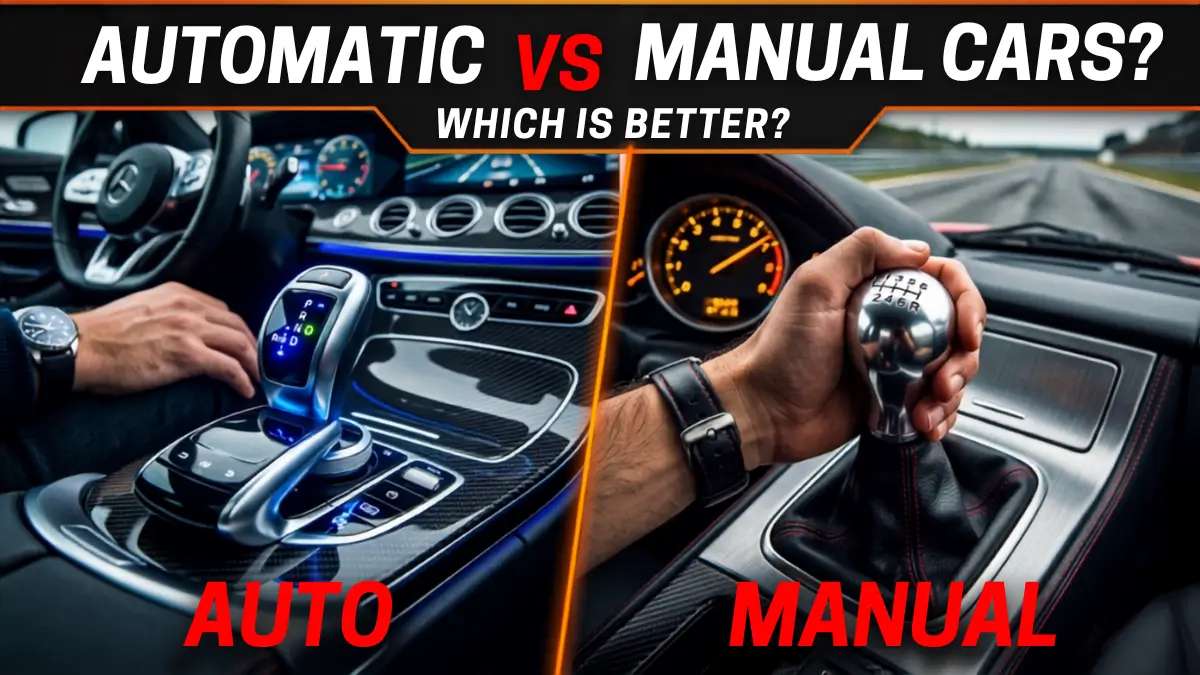
Manual vs Automatic Car: Which One Should You Buy? (2026 Complete Guide)
The core difference between a manual vs automatic car is who shifts the gears. In a manual car, you shift them. In an automatic car, the car itself shifts them for you.
That single difference then shapes everything else: what the car costs, how it feels to drive, how much fuel it burns, and the resale value. Here I break down all this, and by the end you'll know exactly which type of car to buy.
What Is the Difference Between a Manual vs Automatic Car?
What Is a Manual Transmission?
A manual car, also called a stick shift, gives you full control of the gears. You press the clutch to disconnect the engine from the gearbox, shift into the gear you want, and release the clutch to reconnect the engine to the gearbox. It takes coordination between your left foot, your right foot and your hand — a learning curve that puts you in direct control of the car.
What Is an Automatic Transmission?
An automatic car shifts the gear for you. There is no clutch pedal, just an accelerator and a brake. A Transmission Control Unit monitors your speed, throttle input and engine load, then picks the right gear. You select "D" and drive. That simplicity is why automatics have surged in popularity with new drivers and city commuters.
How Each Gearbox Works
Both automatic and manual transmissions do the same job: they take power from the engine and deliver it to the wheels using a set of gears with different ratios. Lower gears provide more power at low speeds, while higher gears keep engine revs low at cruising speed.
In a manual, you choose the gear. In an automatic, a torque converter (or a clutch pack, depending on the type) and a control unit handle the ratio changes for you, seamlessly and without any input.
Manual vs Automatic Car: Quick Comparison Table
|
Factor |
Manual Car |
Automatic Car |
|
Purchase price |
Lower |
Higher |
|
Fuel efficiency |
Marginal edge in some cars |
On par, often better on highways |
|
Maintenance |
Cheaper, simpler |
Higher, more complex |
|
Resale value |
Traditionally strong |
Rising, commands a premium |
|
Ease of driving |
Steeper learning curve |
Beginner-friendly |
|
Control and engagement |
Excellent |
Good, less involved |
|
Best for |
Enthusiasts, budget buyers |
City commuters, convenience seekers |
Types of Automatic Transmissions Explained (AMT vs CVT vs DCT vs Torque Converter)
Not all automatics are the same. The "automatic" badge covers four very different technologies, each with its own feel, cost, and reliability profile.
-
AMT (Automated Manual Transmission)
An AMT is essentially a manual gearbox with a robot doing the clutch work. Used in budget cars like Tata Tiago since it’s the cheapest automatic option. The trade-off is a noticeable "head-nod" or shift lag between gears.
-
Torque Converter
Torque Converter is the oldest and most proven automatic used in cars like Hyundai Creta and Innova Crysta. It uses fluid to transfer power — delivering smooth, reliable shifts and copes well with heat and heavy use. Although, it's not the most fuel-efficient automatic transmission option, but it's arguably the most durable.
-
DCT (Dual-Clutch Transmission)
A DCT uses two clutches, one for odd gears and one for even, to deliver lightning-fast, sporty gear shifts. It's the choice for performance-oriented cars like Kia Seltos. The downside is that some DCTs can struggle with heat in heavy stop-and-go traffic and tend to be more expensive to repair.
-
CVT (Continuously Variable Transmission)
A CVT uses pulleys and a belt to mimic an infinite range of gear ratios, giving smooth, seamless acceleration and excellent fuel economy. The only quirk is the "rubber-band" sensation, where engine revs climb before the car catches up, which some drivers who drives prefacelifted Honda City or Maruti Baleno notice sometimes.
Automatic Car Transmission Types at a Glance
|
Type |
How It Works |
Best For |
Key Advantage |
Main Drawback |
|
AMT |
Manual gearbox with a robot clutch |
Budget cars |
Cheapest automatic |
Head-nod between shifts |
|
Torque Converter |
Fluid transfers power to the wheels |
Long-term reliability, heavy use |
Smooth and durable |
Less fuel-efficient |
|
DCT |
Two clutches for odd and even gears |
Performance cars |
Fastest shifts |
Heat sensitivity, costly repairs |
|
CVT |
Pulleys and belt mimic infinite ratios |
City commuters |
Smooth, efficient |
Rubber-band feel |
Manual vs Automatic Car: Pros and Cons
Pros and Cons of a Manual Car
|
Pros |
Cons |
|
Lower purchase price |
Steeper learning curve |
|
Cheaper and simpler maintenance |
Tiring in heavy traffic due to constant clutch work |
|
Better driver control and engagement |
Requires more coordination |
|
Strong performance feel |
Increasingly limited model availability |
|
Better city fuel economy |
Pros and Cons of an Automatic Car
|
Pros |
Cons |
|
Effortless to drive |
Higher upfront cost |
|
Excellent in stop-and-go traffic |
More expensive repairs |
|
Beginner-friendly |
Mechanical complexity |
|
Smoother experience |
Lowerfuel-efficiency |
|
Rising resale value |
Manual vs Automatic Car: Cost Comparison
Purchase Price
A manual is almost always cheaper to buy. How much cheaper depends on which automatic you pick, and the gap widens as the gearbox gets more sophisticated.
Take the Maruti Suzuki Swift. The VXi manual variant is priced at ₹6.59 lakh and the VXi AMT at ₹7.04 lakh. Move up a trim and the ZXi manual is priced at ₹7.53 lakh against ₹7.98 lakh for the ZXi AMT — a consistent ₹45,000 premium across the range.
Maintenance and Repair Costs
Manual cars are mechanically simpler, so routine maintenance and clutch replacements are generally cheaper. Automatics rely on more complex components and electronics, which makes repairs pricier, though some types like CVTs and torque converters can be low-fuss over a normal ownership period.
A clutch repair on a hatchback like the Swift or Hyundai i20 typically cost about ₹8,000 to ₹15,000, with the clutch kit itself costing roughly ₹3,000 to ₹7,000 and labour adding a few thousand more. It is usually needed somewhere around the 80,000 to 1,00,000 km mark.
An AMT uses the same clutch assembly, so that cost carries over almost unchanged, and its main additional part is the actuator, which runs around ₹15,000 to replace. The genuinely expensive failures belong to the more complex gearboxes: a DCT mechatronic unit repair is commonly quoted between ₹80,000 and ₹1.3 lakh, while a full CVT or DSG gearbox replacement can cost ₹1.5 lakh to ₹2.5 lakh and beyond once the car is out of warranty.
These are worst-case figures rather than routine ones, but they explain why on-time transmission fluid changes and a clean service history matter far more on an automatic than on a manual.
Resale Value and Depreciation
Historically, manuals held their value better, but buyer demand has been shifting toward automatics. India is following that path, just more slowly than most people assume. Used-car data show automatics accounted for only 3.8% of used Swift sales in 2024, up from 1.56% in 2021, compared with a national used-automatic share of 14.66%.
Where the automatic wins is on the price it fetches. The average used petrol Swift with a manual sold for about ₹4.39 lakh, while the petrol automatic averaged ₹7.12 lakh, though the automatic pool is younger and better equipped. The Swift’s five-year value retention is up to 73%. Applied to the ex-showroom prices above, the ₹6.59 lakh VXi manual would come back at roughly ₹4.81 lakh and the ₹7.04 lakh VXi AMT at roughly ₹5.14 lakh, so the automatic hands back around ₹33,000 of the ₹45,000 premium you paid for it.
5-Year Total Cost of Ownership: A Quick Example
Now the real question is what you’ll spend over five years. Take the Swift VXi, because it is the same car with only the gearbox changing: ₹6.59 lakh as a manual and ₹7.04 lakh as an AMT, a ₹45,000 head start for the manual.
Now add fuel. At 12,000 km a year you cover 60,000 km in five years. The manual’s 24.8 kmpl and the AMT’s 25.75 kmpl (ARAI) work out to roughly 2,419 and 2,330 litres, and at Delhi’s petrol rate of ₹102.12 a litre that is about ₹2.47 lakh against ₹2.38 lakh. The AMT claws back close to ₹9,000. Servicing is broadly similar at this mileage, since a clutch normally lasts 80,000 to 1,00,000 km and both cars use one, so give the AMT an extra ₹3,000 for a transmission-oil change.
Finally subtract resale at that 73% retention: roughly ₹4.81 lakh for the manual and ₹5.14 lakh for the AMT. Purchase minus resale, plus fuel and servicing, leaves the manual at about ₹4.25 lakh and the AMT at about ₹4.31 lakh over five years. The ₹45,000 showroom gap shrinks to roughly ₹6,000. This is an ex-showroom comparison and leaves out insurance and registration, but the lesson stands: run these four numbers for the specific models you’re considering before deciding on price alone.
Manual vs Automatic Car: Which Gives Better Mileage?
Fuel Efficiency in City Traffic
In city driving, manuals traditionally have a slight edge because the driver decides exactly when to shift, avoiding unnecessary gear changes. That said, modern automatics have closed this gap considerably.
Add real mileage figures
Fuel Efficiency on Highways
On highways, many modern automatics actually match or beat manuals. With more gear ratios available (some automatics have eight or nine speeds), they keep the engine in its most efficient range at cruising speed.
Fuel Efficiency in Hilly Terrain
On hills, control matters. Manuals let you hold a lower gear for climbs and engine braking on descents. However, automatics with manual or sport modes now offer similar control, making the difference smaller than it used to be.
The bottom line on mileage: the old belief that manuals always save fuel no longer holds universally. Modern automatics are highly competitive, and in some cases more efficient.
Driving Experience: Manual vs Automatic Car
Ease of Driving and Learning Curve
An automatic is far easier to learn and drive. There's no clutch to master and no risk of stalling at a junction. A manual demands more skill and practice, which is rewarding for enthusiasts but stressful for some, particularly in dense traffic.
Performance and Control
Manuals give you direct control over power delivery, which enthusiasts and performance drivers prize. Yet modern automatics, especially DCTs, can shift faster and more smoothly than any human, so for outright performance the automatic often wins today.
Safety and Real-World Nuances
Beyond the basics, a few practical factors deserve attention. Manuals offer strong engine braking on long descents and precise momentum control for towing or light off-roading. They also allow confident hill starts once mastered, though clutch fatigue in bumper-to-bumper traffic is real. Automatics remove that fatigue entirely and let you keep both hands and full attention on the road in an emergency, which many drivers consider a genuine safety benefit in busy conditions.
How to Drive an Automatic Car (and Can You Stall One?)
Driving an automatic is straightforward: press the brake, shift into "D," release the handbrake, and gently lift off the brake to creep forward, then accelerate.
To stop, brake as normal; to park, shift to "P."
And can you stall an automatic? It's very rare, since there's no clutch, but a failing torque converter can occasionally cause it.
Manual vs Automatic Car: Which Should You Buy?
Who Should Buy a Manual Car?
Choose a manual if you're on a tighter budget, love driving and want maximum control, enjoy the engagement of shifting yourself, or frequently drive on open roads or challenging terrain where precise control helps.
Who Should Buy an Automatic Car?
Choose an automatic if your commute involves heavy traffic, you want the easiest possible driving experience, you're a new or nervous driver, or you simply value comfort and convenience and don't mind paying a premium for it.
A Simple Decision Framework
Choose manual if: budget is tight, you love driving, and traffic is light.
Choose automatic if: you drive in city traffic often, want ease and comfort, or share the car with less confident drivers.
Test-Drive & Buying Checklist
Before you commit, test drive both types in real conditions, including traffic and hills. In an automatic, note the transmission type (AMT, CVT, DCT, or torque converter) and how smoothly it shifts. In a manual, check clutch feel and gear engagement. Ask about maintenance schedules, warranty coverage on the gearbox, and resale demand for that model in your area.
The Future: Manual vs Automatic Car in the EV Era
There's one more factor reshaping the manual vs automatic car conversation: electrification. Electric cars are effectively single-speed and drive like automatics, with no clutch or gear stick at all. As more markets move toward phasing out new petrol and diesel vehicles, the manual gearbox is gradually declining. If you expect to switch to an EV within a few years, that reality may tilt your decision toward getting comfortable with automatic-style driving now, though enthusiasts will likely keep the manual alive as a passion choice for years to come.
Common Myths About Manual vs Automatic Car
Below are some common myths that I so often hear my friends talk about. And your friends might have the same myths — so let’s break them down.
"Manuals always save fuel." Not anymore. Modern automatics often match or beat manuals, particularly on highways. Like which car
"Automatics aren't fun to drive." DCTs and well-tuned automatics with sport modes deliver fast, engaging performance that rivals or exceeds many manuals. Like the car
"Automatics are unreliable." Torque converters and CVTs have proven durable over long ownership periods; reliability depends far more on the specific type and maintenance than on the "automatic" label itself.
Conclusion: Manual vs Automatic Car
There's no single winner in the manual vs automatic car debate, only the right choice for you. A manual rewards you with lower costs, more control, and pure driving engagement. An automatic delivers unmatched ease, comfort, and traffic-friendly convenience, with resale values and fuel efficiency now firmly on its side. Weigh your budget, your daily driving conditions, and your priorities, and the answer will become clear. Whichever you choose, understanding these trade-offs means you're buying with confidence rather than guesswork.
About the Author

Bharat Rana shares practical insights on cars, ownership, and the latest updates to help readers make informed decisions.